
The riddle of the mealworms
To understand heredity, Nettie Stevens chose to study the mealworm (Tenebrio molitor). Why? Because they are easy to raise and their cells are large enough for the microscopes of the time. She focused on the production of gametes (sex cells: sperm and eggs).

The crucial observation
While observing male cells, she noticed something incredible. There were two types of sperm:
- Half contained a full set of 10 large chromosomes.
- The other half contained 9 large chromosomes and 1 very small one.
For females, it was simple: all eggs contained 10 large chromosomes.
"She was the first to understand that sex was not a coincidence, but a biological equation."
The conclusion: the small one decides
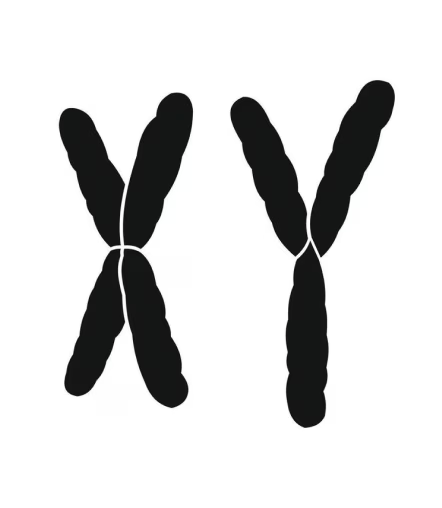
She named the large chromosome "X" and the small one "Y". The calculation was simple:
- If an egg (X) is fertilized by a sperm (X) = XX. You get a female.
- If an egg (X) is fertilized by a sperm (Y) = XY. You get a male.
She proved that sex is a hereditary trait determined by the father, via this small Y chromosome. This discovery is the foundation of all modern sexual genetics. The fact that a patriarchal system chose to ignore it does not diminish her genius.